
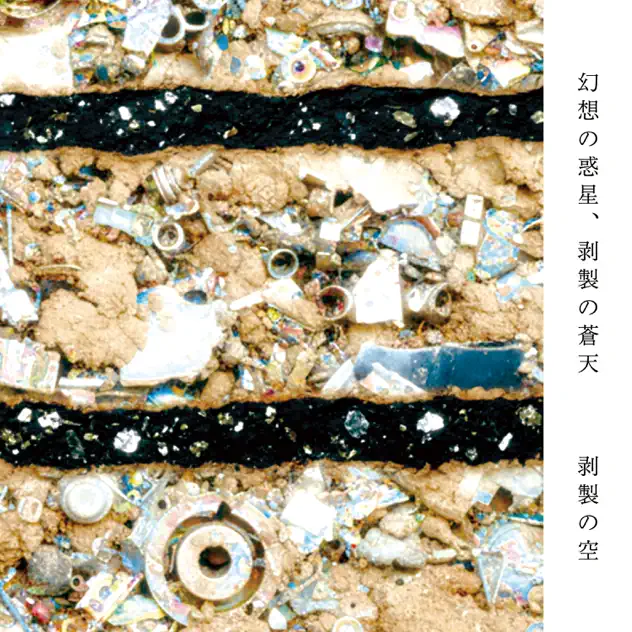
Hakusei No Sora
Gensou No Wakusei, Hakusei No Souten
Hakusei No Sora
Gensou No Wakusei, Hakusei No Souten
- release date /2026-05-29
- country /Japan
- gerne /Alternative, Ambient, Blackgaze, Dream Pop, Folk, Post-Black Metal, Post-Classical, Post-Rock, Shoegaze
The debut album from Tokyo shoegaze/post-rock band Hakusei No Sora.
Formed in 2017 by brothers Kôhei Sugiyama (guitar/piano) and Yusuke Sugiyama (vocals/guitar), Hakusei No Sora released their first EP, “Ame No Naka, Hikari Afurete,” in 2019. Built on shoegaze and post-rock, their sound combines delicate ambience with walls of guitar noise, creating a dynamic and immersive soundscape. An innocent, crystal-clear vocal style intertwines with melancholic melodies colored by a distinctly Japanese sensibility, shaping a world that unfolds like a story.
Completed after roughly four years of production, with the members separating and later reuniting, Gensou No Wakusei, Hakusei No Souten expands their established sound with violin, cello, and flute. These new elements add greater depth and a more cinematic quality to the arrangements.
Centered on the theme of “destruction and rebirth,” the album alternates instrumental and vocal tracks. The instrumentals function like narrators connecting the chapters of a larger story, while the vocal songs unfold with poetic lyrics reminiscent of old songbooks, folktales, and oral traditions. Between silence and roaring guitars emerge distinctly Japanese images: grasses swaying in the wind, crimson clouds drifting across the sky, and the changing seasons. The nostalgic melodies often recall childhood songs, giving the music an almost folkloric quality. The combination of these melodies with shoegaze and post-rock’s immense guitar sound brings to mind a distinctly Japanese take on Alcest.
Few bands that blend traditional or folk influences with shoegaze, such as Alcest and Sylvaine, embody that approach through such a strongly Japanese sensibility. The album’s use of melodies rooted in traditional Japanese scales, combined with the expansive sound of post-rock and shoegaze, may offer international listeners a distinctive Japanese atmosphere, with echoes of wabi-sabi.
The album is consistently strong, but #8, “Rinretsu Taru Ginsekai Wa Keishou No Gotoku,” stands out in particular. After beginning with a delicate, unhurried passage, the track erupts into a blizzard of guitar noise and blast beats. Its sudden turn toward post-black metal and blackgaze is dramatic, but far from arbitrary.
Kôhei Sugiyama’s previous involvement with post-black metal band desire of the moth provides a clear link to this darker impulse. Beneath Hakusei No Sora’s delicate beauty runs a distinctly blackened current.
The CD edition also adds two tracks to the 10-track digital version: #11 “Saisei No Kehai” and #12 “Taerareru Dake No Uryou De”. Of the two, “Saisei No Kehai” serves as a true epilogue to the album’s story.
In a world that has already come to an end, the protagonist wanders through a barren, desolate landscape, yet realizes that life still remains—that they are still breathing. Having lost everything, they begin to dream of tomorrow once again. By turning its gaze toward rebirth after destruction, the track quietly brings the album’s central theme to a close.
The album should appeal not only to fans of post-rock, shoegaze, post-black metal, and blackgaze, but also to listeners drawn to composers such as Joe Hisaishi, Akiko Shikata, Michiko Naruke, and Keiichi Okabe. For those looking to immerse themselves in a melancholic and fantastical world, Gensou No Wakusei, Hakusei No Souten is well worth exploring.
Folklore or Science Fiction? Unraveling the Lyrics of Gensou No Wakusei, Hakusei No Souten
The lyrics deserve as much attention as the music itself.
Written around the theme of destruction and rebirth, they use archaic, literary Japanese that evokes ancient chronicles, myths, and folk songs. At first glance, the album seems to tell an old tale from a distant age.
Look closer, however, and a surprising layer of science fiction begins to emerge.
For example, #2, “Manten No Kyozou Ni Yumemita Kodou Wa,” describes a protagonist tracing records left behind by those who came before, following fragments of knowledge preserved from a distant past.
#6, “Aseta Hekiraku Yori Hibiku Kodama O,” evokes a lullaby carrying the memory of another land and the final days of a civilization. Meanwhile, #8, “Rinretsu Taru Ginsekai Wa Keishou No Gotoku,” speaks of the return of a lost history beneath a world consumed by snow and cold. The recurring imagery suggests that the catastrophe of the past may be repeating itself.
In this reading, the traditions passed down through generations were once records of scientific facts and a forgotten civilization. After that civilization collapsed, their original meaning was lost, and those records gradually became folktales, lullabies, and oral traditions.
In that sense, the moment when the protagonist encounters the records of the past recalls the revelation of the “Black History” in Turn A Gundam, where the truth of a forgotten civilization is finally exposed.
There is another, even more intriguing clue: the nature of the world itself.
Several passages suggest that the sun may not be natural at all, but something projected or artificially created. One lyric refers to a “virtual present,” while another describes the world as a fiction created by the sun.
This opens up the possibility that the planet itself, along with its sky and sun, is an artificial or virtual world created by an unknown force.
Seen from this perspective, the album title, Gensou No Wakusei, Hakusei No Souten, takes on a deeper meaning. A “taxidermied” sky suggests something preserved after its original life has disappeared. An artificial planet and an artificial blue sky could be an archive of a world that once truly existed.
Of course, this is only one possible interpretation of the lyrics. The album never provides a definitive answer, and that ambiguity is part of its appeal. The deeper you look, the more its seemingly ancient mythology begins to reveal the outline of a science-fiction story.
By presenting a tale of destruction and rebirth in language reminiscent of old folklore, while quietly embedding futuristic ideas and technological imagery within it, Hakusei No Sora creates something resembling a narrative trick. The contrast gives the album’s world an unexpected depth.
The lyrics also contain a considerable amount of difficult, archaic vocabulary. It may seem intimidating at first, but with a smartphone at hand, following the meanings of these words becomes part of the experience. The more closely you unravel them, the more hidden layers begin to emerge.
Anticipating the Full-Band Live Experience
It will be interesting to see how Hakusei No Sora recreate the album’s expanded arrangements live, particularly with the strings and flute introduced on this record. At sonorium, the white, cathedral-like concert hall in Eifukucho, Tokyo, the combination of these arrangements and the venue’s acoustics could make for an especially memorable performance.


