
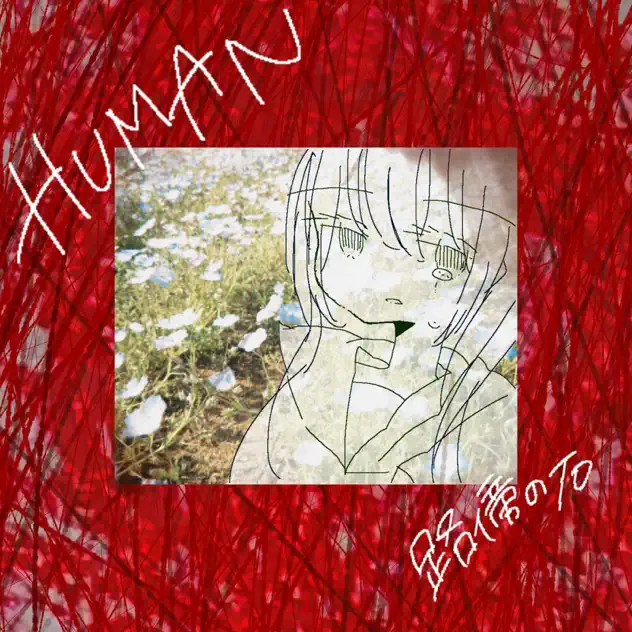
robounoishi
HUMAN
robounoishi
HUMAN
- release date /2025-11-12
- country /Japan
- gerne /Alternative Rock, Grunge, Noise, Post-Hardcore, Post-Rock, Shoegaze
The tenth album from Tokyo-based vocaloid producer and alternative rock project robounoishi.
The production lineup consists of Haruka Higashi (vocals), Sensha (guitar), Yurei Daisuki Lab! (guitar), Kurushimi (bass/vocals), and Tsukino (drums). Across the record, ten selected tracks from the project’s catalog are reimagined through full band arrangements, transforming them into something far more visceral and corporeal. The result is a thick, physically charged sound that feels as if it is being delivered at point-blank range from a live house PA system, with enough force to suggest vibration in the air itself. Compared to their original versions, the difference is immediate and unmistakable.
For shoegaze listeners, the standout entry is #7 “phantom girl in summer.” Dual male and female vocals intertwine in luminous harmony before dissolving into a storm of distortion, achieving a textbook example of shoegaze catharsis. Lyrically, it draws from the standardized “ideal summer beach girl” archetype often found in narrative-driven ADV games—a fantasy that was widely recognized as illusionary even as it remained culturally desirable. Beneath its sonic beauty, the track carries a subtle psychological sting, evoking a sense of unresolved longing that may feel uncomfortably familiar to some listeners.
#4 “Reiketsu” stands out for its striking duality: an infectious melodic line that invites humming, locked in tension with engine-like, abrasive noise textures. The contrast is executed with precision, echoing an aesthetic lineage traceable to The Jesus and Mary Chain’s Psychocandy, where pop sensibility and sonic violence coexist without compromise. Elsewhere, tracks such as #1 “suicide snowcide,” #2 “Yasashisa Wo Atsumete,” and #5 “Yucky” offer more immediate melodic accessibility, underscoring the project’s consistent strength in songwriting and hook construction.
The album’s darker axis is where robounoishi becomes most compelling. That impulse reaches its peak on #9 “Dxm (Watashi Ga Mita Tenshi No Yume),” where melancholic melody, overwhelming noise, clean vocal lines, and unrestrained screams collide in a destabilizing sonic mass. The track feels less like composition and more like a transcription of cognitive collapse, intensified by its bleak lyrical imagery. Subtle embedded cues and lyrical fragments function as Easter eggs scattered throughout the piece, reinforcing its layered interpretive structure. It is an intense listening experience that may be overwhelming for those without a tolerance for such psychological density.
In contrast, #10 “see you” closes the album with suspended clarity: a drifting shoegaze piece built on airy textures and a sense of release. However, attentive listeners will notice embedded cues—both in the lyrics of “Dxm (Watashi Ga Mita Tenshi No Yume)” and in subtle SE details within the intro of “see you”—that complicate any reading of straightforward resolution. It does not represent salvation; rather, it suggests a profound complexity that refuses to settle into any stable emotional endpoint.
Following the album’s release, drummer Tsukino and guitarist Sensha departed from the lineup. The project subsequently resumed full-band activity from the April 19 one-man live with new members, delivering a full reconstruction performance of HUMAN alongside a setlist that hinted at its next phase. The inclusion of “Koya Nite” from the blackgaze work Pater Noster demonstrated a deliberate push toward more extreme sonic territory.
True to its title, HUMAN functions as a consolidation point: vocaloid-origin material reanimated through human performance, solidifying the trajectory of robounoishi up to this stage. Yet it remains only a milestone. The creative momentum of Kurushimi continues to expand beyond it, with subsequent releases already reflecting the “more aggressive sound” foreshadowed in the live performance. Rather than retracing established paths, the project consistently advances into less charted territory—an approach that defines its core alternative ethos and suggests that its most volatile phase may still lie ahead.


