
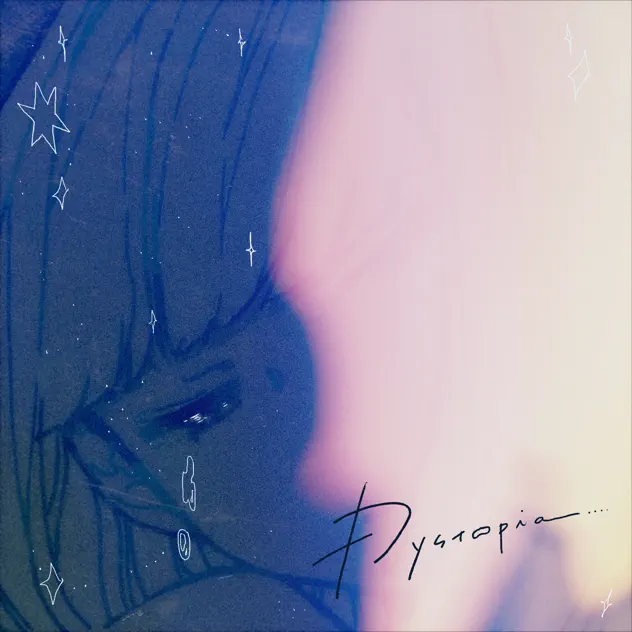
Blurred City Lights
Dystopia
Blurred City Lights
Dystopia
- release date /2025-02-07
- country /Japan
- gerne /Alternative Rock, Ambient, Dream Pop, Post-Rock, Shoegaze
The second album from Japanese shoegaze band Blurred City Lights.
Structured as a two-part work titled “Utopia” and “Dystopia,” this section focuses primarily on “Dystopia.”
In contrast to the radiance of “Utopia,” “Dystopia” functions as the album’s shadow. Its melodies are less overtly catchy, shaded instead with restraint and introspection. The band further amplifies delicate ambient textures and post-rock techniques reminiscent of Sigur Rós, unfolding a deeply immersive soundscape. The composer credits frequently list guitarist Megumi, suggesting that his aesthetic sensibilities may play a significant role in shaping this darker half.
The opening #1 “dreamland” introduces an ethereal atmosphere pierced by pulsing tones that evoke a vast, unbounded cosmos. On #2 “Whisper,” the lyrics dwell on an inability to escape “the beginning of eternity,” expressing quiet resignation. References to external memory and protocols hint that the pastoral world of “Utopia” has subtly advanced into a more technologically inflected future.
#3 “shinjuku” begins with the sound of a cassette tape rewinding, intermittently disrupted by uneasy pulses. The instrumental suggests an ominous premonition. #4 “Bourei Toshi” unfolds as a melancholic piece where fragile arpeggios fall like ash, tracing sorrow for a ruined civilization. A brief shift to a slightly faster tempo near the end feels like a final surge of strength—an attempt to reach for someone already lost.
The centerpiece is the nine-minute epic #5 “Kimi No Koe.” Structured around a gradual dynamic ascent from stillness to overwhelming force—recalling the dramatic arcs of Mono or Explosions In The Sky—the track culminates in a massive eruption of sound that suggests something cosmic in scale, akin to a supernova or even a Big Bang. The closing piano instrumental, #6 “the end of Dystopia?”, brings the record to a quiet pause. Its tonal resemblance to “Utopia”’s #5 “utopiaflorist” subtly implies a hidden symmetry between the two worlds.
Taken together, “Utopia” and “Dystopia” resemble opposing forces that complete one another, much like the yin–yang symbol. Yet the work appears to invite deeper interpretation.
The key lies in #3, “shinjuku,” from Dystopia. At first, the album seems to unfold within a purely imagined world. Yet the sudden appearance of the real place name “Shinjuku” introduces the possibility that this narrative is contiguous with our own reality. Like the Statue of Liberty in Planet of the Apes, it functions as a masterful narrative twist.
The word “Shinjuku” also brought to mind another association: the E ending of the game Drakengard, commonly known as the “Shinjuku ending.” Even among its so-called “multi–bad endings,” it stands out as particularly shocking—an experience that left countless players feeling as though their brains had been seared. It is well known among fans that this ending serves as the narrative origin point for what would later unfold in NieR Replicant and NieR: Automata. Moreover, beginning with NieR Replicant, the NieR series reveals hidden truths on subsequent playthroughs, overturning the player’s assumptions and inverting their understanding of the story. This structural reversal resonates uncannily with the dual, interdependent construction of “Utopia” and “Dystopia.”
Within the NieR series itself, there are scattered suggestions of a reconnection to the world of Drakengard, allowing the two franchises to be interpreted as forming a mutually interfering spiral structure. The question mark appended to the album’s closing track, “the end of Dystopia?”, likewise implies that dystopia does not arrive at any definitive conclusion.
In this light, might “Dystopia” return to “Utopia,” and “Utopia” to “Dystopia,” revolving in a spiral rather than progressing along a straight line? Like the sun rising, setting, and rising again. Or like the oscillating universe hypothesis, in which the cosmos expands from a Big Bang, contracts toward a Big Crunch, and is born anew. Perhaps listeners themselves are caught within such a spiral—one without true beginning or end (here, the lyrics from Whisper, “We cannot escape from the eternal beginning,” gain new resonance).
Even the CD design reinforces this interpretation: the titles “Utopia” and “Dystopia” are arranged in point symmetry on the disc face, maintaining the same layout when rotated 180 degrees. Which comes first, and which follows? If the two works were divided in order to unsettle that very assumption, there may be only one recommended way to listen: connect them in a single playlist, set it to loop, and surrender to the eternal spiral.
Perhaps this is mere speculation. Yet the album possesses enough structural and emotional coherence to sustain such a reading. In that sense, Blurred City Lights feels like a band that grants listeners wings to soar into boundless imagination.
For those discovering Blurred City Lights through this release, their true force may be experienced most fully in a live setting. The sheer density of sound they generate as a trio can be startling. The band has also shared breakdowns of their guitar textures on YouTube for listeners interested in the mechanics behind the distortion-laden sound. Blurred City Lights – Shoegaze Guitar Effects & Riff Breakdown
The CD and Bandcamp editions include bonus tracks: “Yudachi” on “Utopia” and “sumire” on “Dystopia.” Both further demonstrate the band’s distinctive sensibility and are well worth seeking out.
Previous review: Blurred City Lights – Utopia


