
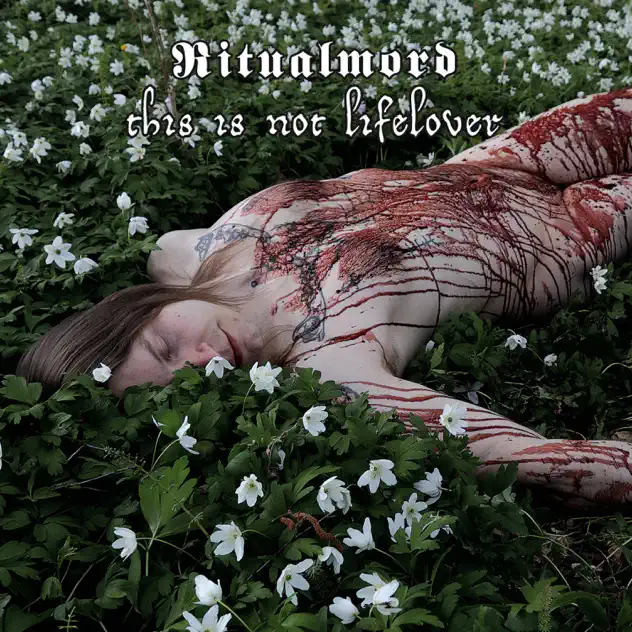
Ritualmord
This is not Lifelover
Ritualmord
This is not Lifelover
- release date /2025-03-08
- country /Sweden
- gerne /Ambient, Blackgaze, Depressive-Black-Metal, Folk, Industrial, Post-Black Metal, Post-Rock
The debut album from Swedish band Ritualmord.
Ritualmord was formed in 2007 by Kim Carlsson—one of the founding members of Swedish depressive black metal band Lifelover—and 1853, though the project did not begin operating in earnest until 2020. Given the striking visual similarity to Lifelover’s first album, combined with the deliberately provocative title “This Is Not Lifelover,” some listeners may initially find themselves disoriented.
The title, however, appears to be both a tribute and a declaration. While acknowledging Lifelover’s 20th anniversary and its enduring shadow, Ritualmord explicitly distances itself from that legacy—an assertion that feels intentional in a context where any related project would inevitably be measured against the original. Listening to the album makes that distinction clear. Rather than revisiting a single stylistic lane, the material blends ambient, folk, and industrial elements with post-rock and shoegaze textures, forming a palette that feels markedly broader than Lifelover’s core sound.
That said, traces of lineage remain. Some tracks were reportedly written with Lifelover in mind, though never realized at the time, and Carlsson’s unmistakable screams—strategically placed rather than omnipresent—inevitably evoke the band’s DNA. Still, the overall atmosphere diverges in meaningful ways. Where Lifelover drew heavily from the Brave Murder Day-era Katatonia strain of depressive black metal, Ritualmord leans toward a dreamier, more expansive territory, edging into blackgaze and post-black metal.
What emerges is not a continuation, but an alternative—a project that carries faint remnants of Lifelover while articulating a different set of possibilities. One might reasonably describe Ritualmord as a “Lifelover alternative,” not in opposition, but in parallel. As a debut, the album occasionally suggests a band still exploring its range, yet there is a sense that the shoegaze and post-rock components may grow even more pronounced going forward.
Freed from the weight of expectation that inevitably accompanies a legacy act, Carlsson and 1853 appear poised to chart their own course. How this newly defined world evolves is an intriguing prospect. For additional context, listeners may also want to explore Kall, another project involving Kim Carlsson, which offers a distinct but equally individual perspective.


